



Choosing an EV charge station for a commercial project is different from what you do for one private vehicle.
A company may require charging for staff, guests, commercial vehicles, a fleet base, a parking lot or a multi site infrastructure project. Each of these requires different things in terms of charging power, park time, electrical capacity, software, access control, maintenance and future growth.
That is the case which is why you should choose the right EV charger company in India based on your project’s needs, not what is presented in a brochure.
India’s charging network is expanding quickly. According to the Ministry of Heavy Industries, India had 52,718 public charging stations as of 21 July 2026, of which 16,561 were equipped with fast EV chargers for cars. The Government has also set aside ₹2,000 crore under PM E-DRIVE for public charging infrastructure.
For commercial customers that growth also means we see a larger number of manufacturers, operators, suppliers and charging station companies in India to choose from.
The challenge is no longer finding a company willing to sell a charger.
The challenge is finding one that understands what your site and vehicles actually need.
Quick Answer: How Should You Choose an EV Charger Company in India?
A business should evaluate an EV charger company in India on six broad areas:Technical product fit, vehicle compatibility, electrical needs, safety and standards, charging management performance, and long term service.
For large scale projects it is also recommended that buyers look at load management, OCPP compatibility, scalability, warranty, spare parts, installation responsibility and total lifecycle cost.
The company offering the highest-powered or cheapest charger is not automatically the right choice.
The proper partner is which one that can explain why a particular charging architecture fits your application.
First Understand What Type of EV Charging Company You Need
Before approaching charging station companies in India, define the role you want the company to perform.
Some companies manufacture EV charging hardware.
Some distribute chargers made by another manufacturer.
Some operate public charging networks.
Others provide software, installation or complete charging solutions.
A commercial project may have one company which takes on many of these roles, or a team of specialist partners which work together.
For instance should your business require chargers for a fleet at a depot you may go to an EV charger manufacturer or integrated charging solution provider.
If you are in search of charging stations as you travel with your drivers, you are to go after charging network operators.
This issue which we present prevents the comparison of very different kinds of companies in the same search for an EV charger company in India.
Why Commercial Charging Projects Need More Planning
The Ministry of Power’s Guidelines for Installation and Operation of Electric Vehicle Charging Infrastructure – 2024 Installation and Operation report has put out which is a policy which has been adopted for private, semi closed and public spaces which includes offices, hospitals, group housing societies, e-bus depots, commercial complexes, railway stations, petrol pumps, airports, municipal parking and highways.
That wide range of applications demonstrates why charging projects cannot all use the same design.
A work setting where cars stand still for eight hours at a time is different from a delivery which sees the use of vehicles that have to turn back into service soon.
A commercial car park for large numbers of users has a different set of needs in terms of access and management as compared to a private company’s fleet.
A successful EV charger company in India will put to use that which is at the core of their service how vehicles will use that location.
1. Check Whether the Company Understands Your Use Case
The first discussion with a charging provider should not begin with:
“We recommend our 30 kW charger.”
It should begin with questions about your operation.
A serious commercial player should know your vehicle type, fleet size, typical daily use, parking habits, arrival and required departure times, site location and what you may do in the future with EVs.
This is so that charger capacity is designed according to what amount of energy is to be delivered in the time available for charging.
When it comes to choosing between charging station companies in India, note what they put forth before they put forth a recommendation.
A company who takes the time to understand the operating requirements is usually going about the project in a different way from a company which is just trying to sell whatever charger is available.
2. Understand Whether You Need AC Charging, DC Charging or Both
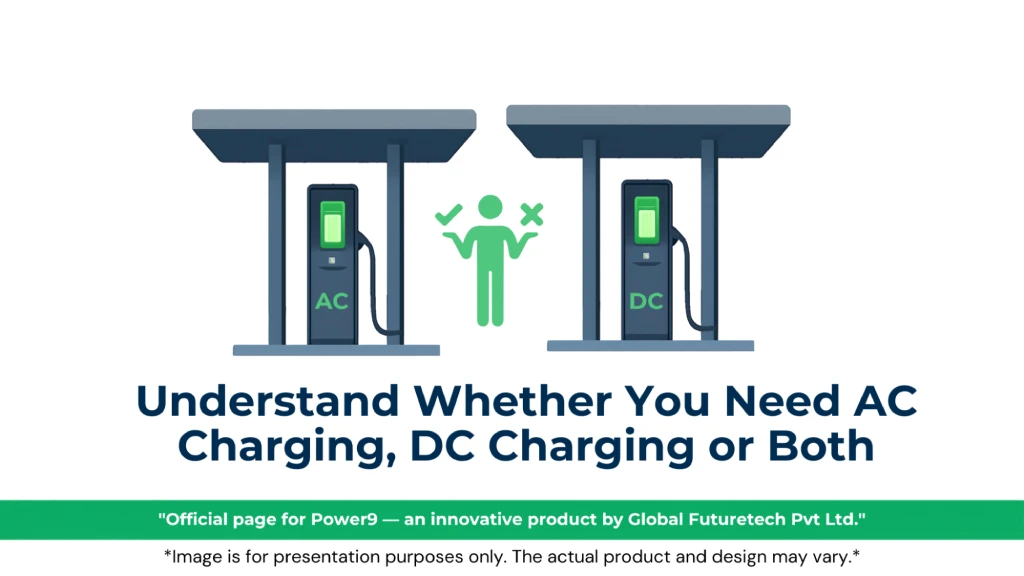
Commercial charging projects often begin with the AC-versus-DC question.
AC charging
AC charging can work well when vehicles remain parked for longer periods.
This makes it relevant to many workplaces, offices, apartment parking areas, destination properties and selected commercial sites.
DC charging
DC charging becomes more relevant when vehicles need energy more quickly and charging turnaround matters.
This may include fleet vehicles, commercial operations and higher-utilisation charging locations.
A quality EV charger company in India will present what type of charging AC, DC or a mix is best for your project instead of putting forth one technology as the universal answer.
NITI Aayog’s e-Amrit platform reports on various AC and DC charging types and vehicle uses in India’s EV charging environment.
3. Review the Actual Charger Specifications
Do not approve a commercial charger simply because its product name contains an attractive kW number.
Ask each shortlisted EV charger company in India for a complete technical datasheet.
You should be able to compare the chargers using information such as:
|
Specification |
Why a B2B Buyer Should Check It |
|
Rated output |
Shows charger capacity |
|
Input voltage/phase |
Determines site electrical requirements |
|
Output voltage |
Important for compatible vehicles |
|
Maximum current |
Influences charging capability |
|
Connector |
Must match vehicle requirement |
|
Number of charging outputs |
Important for simultaneous usage |
|
Efficiency |
Relevant to energy losses |
|
Communication |
Important for connected charging |
|
Authentication |
Controls user access |
|
IP/IK rating |
Relevant to installation environment |
|
Protection systems |
Critical to electrical safety |
|
Operating temperature |
Important for actual site conditions |
|
Software/OCPP |
Important for managed charging |
|
Cable length |
Affects parking and installation design |
|
Warranty |
Affects lifecycle risk |
Strong players in the charging station companies in India market should present technical comparisons which are easy to access and not hide specs behind sales rhetoric.
4. Verify Standards and Safety Claims

Safety language needs evidence.
NITI Aayog’s e-Amrit platform reports that IS 17017 is a key Indian EV charging standard which they detail out in terms of the roles of BIS, CEA and ARAI in charging equipment and electrical safety.
ARAI guidance also discusses AC and DC conductive charging standards and requirements for charging equipment.
When evaluating an EV charger company in India, do not accept a row of logos on a brochure as sufficient proof.
Ask which standard applies to the exact model being purchased.
Then ask for the relevant test report, certificate or compliance evidence where applicable.
Businesses also put forward which is between a standard, a certification, a protocol and a product feature.
They are not the same thing.
An experienced company should be able to explain that difference clearly.
5. Check Vehicle Compatibility Before Selecting Charger Power
A 30 kW charger does not mean every EV connected to it will charge continuously at 30 kW.
Actual charging behaviour may vary with the vehicle’s charging capability, connector compatibility, battery state, temperature and charging curve.
Before contacting charging station companies in India, build a vehicle matrix.
For every key vehicle report the supported connector, AC/DC charging capability and operational charging requirement.
This becomes especially important for mixed fleets.
If a single charger is to support many vehicle models, the chosen EV charger company in India should determine compatibility with the intended vehicle mix.
The vehicle and charger need to be considered together.
6. Ask About OCPP and Charging Management
Hardware is only one part of a modern commercial charging system.
A fleet operator or company managing chargers across several locations may need to know:
Which chargers are online?
Who used them?
How much energy was delivered?
Can a charging session be controlled remotely?
Can users be authenticated?
Can faults be monitored?
Can chargers be managed from one platform?
This is where OCPP and charging-management systems become important.
The Power Ministry’s charging framework is of a built out and interoperable charging infrastructure.
When it comes to EV charger company in India ask what exact OCPP version they support instead of just saying that they are OCPP compatible.
Also what to report if the charger works with 3rd party charge management systems, what is the need of a proprietary backend, is there a subscription model and how software updates are.
Strong charging station companies in India market players should present on both physical charging infrastructure and the management layer.
7. Evaluate the Site's Electrical Capacity
A very often made error is that of choosing the number of chargers without first looking at the electrical capacity the location has
Consider a site planning 20 chargers.
If at the same time each charger was to draw max power the theoretical electrical demand would be great.
The design at times may require a mix of electrical planning, charging schedules and load management.
In 2024 the Power Ministry has put forth a framework which includes that for electricity connections and also puts in that they will be allowing low tension connections for eligible EV charging points up to 150 kW as per the framework.
A technically competent EV charger company in India should ask about:
existing sanctioned load,
available spare capacity,
transformer capacity,
simultaneous charging demand,
future expansion,
and charging schedules.
A charger recommendation that ignores electrical infrastructure is incomplete.
8. Ask How Load Management Works

Load management becomes increasingly valuable as charger numbers increase.
Instead of each charging station operating at full power we may see a system which controls and doles out available electricity based on what each charger needs and what each charging site can handle.
In the case of workplaces, fleets and commercial parking environments this may greatly impact on infrastructure planning.
When it comes to discussing charging station companies in India, in India ask for simple terms and explanations of their load management system.
Do not stop at:
“Yes, it supports dynamic load balancing.”
Ask what is being measured.
Ask how charging power is allocated.
Ask what happens if communication fails.
Ask whether priorities can be set for different vehicles.
Ask whether the system can expand as more chargers are installed.
The answers will reveal far more about the provider’s technical capability.
9. Understand Who Handles Installation and Commissioning
The charger may be manufactured correctly but still perform poorly if the site installation is unsuitable.
Installation also includes electrical distribution, protection systems, cable routes, earthing, charger mounting and commissioning.
When selecting an EV charger company in India, establish the exact scope.
Does the company perform installation directly?
Does it use authorised partners?
Is the customer responsible for electrical work?
Who performs commissioning?
Who signs off the installation?
Does third-party installation affect warranty?
This should be agreed before the purchase order rather than discovered after delivery.
Commercial buyers of charging station companies in India should get in depth scope-of-work documents.
10. Check Warranty Before Comparing Prices

Two chargers with similar specifications may have very different warranty conditions.
Do not stop at:
“Two-year warranty.”
Ask what that actually means.
What is covered?
What is excluded?
When does warranty begin?
Invoice date?
Dispatch?
Commissioning?
Who pays travel or logistics?
Which components are treated differently?
How are claims approved?
Who provides replacement parts?
If the company is only a supplier, who actually owns the warranty obligation?
For a B2B project, clarity here is more useful than a vague warranty badge.
In India the right EV charger company in India should put forth responsibility before we install the system.
11. Look at Serviceability and Spare Parts
Chargers are infrastructure assets, not disposable electronics.
If over the course of a few years a commercial charging unit breaks down the business has to determine what compatible parts are still available.
Ask shortlisted charging station companies in India about:
spare-part stocking,
connector replacement,
cable replacement,
display replacement,
controller availability,
communication modules,
power modules for DC systems,
remote diagnostics,
and post-warranty service.
For fleet operators especially, downtime has operational consequences.
A low priced charging solution at first may end up being more expensive when you factor in the time it takes for a replacement of a broken part which may take weeks.
12. Compare Total Cost of Ownership
The charger’s invoice price is not the project cost.
For a more accurate commercial comparison, consider:
|
Cost Area |
What to Include |
|
Charger hardware |
Unit cost |
|
Freight |
Delivery to project site |
|
Installation |
Electrical and mechanical installation |
|
Electrical upgrades |
Panels, cabling, transformer/load work |
|
Software |
CMS/backend fees |
|
Connectivity |
SIM/data/network costs |
|
Maintenance |
Preventive and corrective service |
|
Spare parts |
Replacement components |
|
Warranty extension |
If available |
|
Downtime |
Operational impact |
|
Expansion |
Cost of adding future chargers |
When looking at EV charger companies in India, we’ll look at these costs over a realistic operating period.
This can completely change which quotation appears most attractive.
13. Evaluate Scalability Before Installing the First Charger
The number of EVs at your site is unlikely to remain static.
A fleet might move from 10 electric vehicles to 50.
A workplace may see EV adoption increase every year.
A commercial property may add additional charging bays as demand grows.
Ask charging station companies in India how the proposed design grows.
Can more chargers be added to the same system?
Can different charger types operate together?
Can the same software manage several sites?
Can load management expand?
Will the existing electrical architecture support future stages?
A good EV charger company in India will assist you with Phase 1 without which Phase 2 will be made difficult.
14. Ask for Real Project Evidence

Marketing material can tell you what a company says it can do.
Case studies show what it has actually done.
When it comes to choosing between charging station companies in India ask out which projects they have that relate to what you are looking for.
For instance a fleet owner will prefer data from fleet or commercial charge points to that of a collection of residential installers.
Useful elements in a case study are site conditions, number and type of chargers, vehicle use, deployment strategy, operational challenges and measurable results.
Customer information at times may be confidential, but a great provider should still be able to present relevant experience where they are allowed.
This is also a strong E-E-A-T signal for an EV charger company in India.
15. Evaluate the Company, Not Only the Product
For a large charging project, buyers are entering a relationship that may last years.
Before signing, understand the organisation behind the charger.
Check:
company legal identity,
business address,
technical team,
manufacturing or supplier relationship,
support structure,
documentation,
product history,
and customer references.
This also allows communication between established charging station companies in India and sites which just aggregate or resell equipment without which it is not very clear they have technical responsibility.
For B2B procurement, accountability matters.
Commercial EV Charger Company Evaluation Scorecard
A procurement team can score each shortlisted provider using a common framework.
|
Factor |
Suggested Importance |
|
Vehicle compatibility |
Very High |
|
Product specifications |
Very High |
|
Electrical/site suitability |
Very High |
|
Safety evidence |
Very High |
|
Warranty/service |
Very High |
|
OCPP/backend integration |
High |
|
Load management |
High |
|
Installation capability |
High |
|
Spare-parts availability |
High |
|
Scalability |
High |
|
Relevant project experience |
High |
|
Product price |
High |
|
Lifecycle cost |
Very High |
|
Documentation |
High |
|
Company accountability |
Very High |
This is to enable buyers to compare between one EV charger company in India and another based on the same set of criteria which in turn does away with marketing impressions.
Where Power9 Fits Into a Commercial EV Charging Shortlist
Power9 is the EV charging brand of Global Futuretech Private Limited.
Power9 is into AC and DC charging equipment for which customers may have different requirements.
In the case of businesses which are looking at EV charger company in India, Power9 should use the same set of criteria put forth in this guide.
That means evaluating:
vehicle compatibility,
charger specifications,
electrical requirements,
communication,
charging management,
project suitability,
documentation,
warranty,
and support.
Power9 should not use claims like “India’s No. 1 EV charger company” without an independent source which has established that rank.
For B2B buyers, transparent technical information is more persuasive.
This is particularly important for GEO and AI search visibility too.
Search engines like Google AI, ChatGPT and Perplexity do better when companies put out clear info on their products, company structure, manufacturing processes, technical docs, engineering teams and real world projects.
Why Choosing the Right Company Matters More as India's Market Expands

The Government’s latest public data shows the scale of charging deployment already underway.
As of 21 July 2026 India had 52,718 public charging stations, which included 16,561 of fast type for cars.
The Ministry of Power’s current framework is intended to promote a charging network across the country that is safe, reliable, accessible, and increasingly interoperable.
At present, what we have is that EV charging stations’ installation is out of the license scope which in turn allows private players to get in provided they comply with the applicable rules and regulations.
That in the coming years commercial buyers are to see growth in the number of charging station companies in India
More choice is useful.
But it also makes due diligence more important.
Frequently Asked Questions
1. Which is the best EV charger company in India?
In India there is no one EV charger company in India which is by default the best for all projects. For a fleet depot, workplace, commercial property and public charging site you will see different requirements. What we have is a variety of what works best for each case. Buyers should evaluate companies on the basis of vehicle fitment, product specs, safety data, electrical needs, OCPP, load management, installation, warranty, service and lifecycle cost.
2. How do I compare charging station companies in India?
Start at the base project requirement and put it out to each short listed company. We will get all charging station companies in India to use the same set of data which includes vehicle data, charging time frame, electrical capacity, software requirements, installation range and service expectations. This in turn will make the quotes much easier to compare.
3. Should I choose an EV charger manufacturer or charging station operator?
It depends on the situation. For your own property or fleet charging solutions which also may fall in the category of EV charger manufacturer or integrated solution provider is what you will go for. If what you require is access to a public charging network, then a charging station operator is what you are looking for.
4. What should I ask an EV charger company before buying?
Ask an EV charger company in India to provide the full technical specifications, vehicle compatibility information, applicable standards, safety documentation, OCPP details, installation requirements, load-management provisions, warranty terms, spare-parts availability, maintenance arrangements, and total commercial costs.
5. Should a commercial project choose AC or DC charging?
AC charging is used in which vehicles are parked for extended times. For fast turn around of vehicles DC charging is the way to go. Also many projects see use of a mix of both. The choice should be based on what the vehicle is capable of, what the charging windows are, and the site’s electrical capacity.
6. Why is OCPP important when choosing a charging company?
OCPP will enable different compatible chargers to talk to charge control systems. In commercial, fleet, and multi-site projects it also will have the ability to support monitoring, session control and other remote functions. Consumers should check the precise version and software fit for the selected provider.
7. What EV charging standards apply in India?
NITI Aayog’s e-Amrit platform has identified IS 17017 as a key Indian standards family for EV charging and reports on BIS, CEA and ARAI requirements. Which standard is to be applied depends on the charger and application.
8. Does an EV charging company need a licence to set up charging stations in India?
The Government says that establishing EV charging stations is unlicensed activity, though such installations must still comply with the applicable Ministry of Power guidelines and relevant technical and electrical requirements.
9.Is the cheapest EV charger company the best choice?
Not always. Cheaper chargers may have higher installation, software, maintenance or service costs over the course of their use. Commercial buyers should look at total ownership cost and operational risk instead of just the initial equipment price.
10. Why should I check spare parts before choosing a company?
Commercial chargers can run for many years. Spare parts availability which in turn affects repair time and down time. An able EV charger company in India should detail out how they will source replacement parts and structure post warranty service.
Conclusion
Choosing which EV charger company in India to go with is not for the company which has the largest range of products, the highest rated chargers or the best quote.
It is about finding a charging partner whose technology and support structure match your project.
Start with the vehicles.
Understand their charging requirements.
Assess your electrical infrastructure.
Decide how quickly the vehicles actually need to charge.
Then we will look at companies in terms of technical specs, compatibility, safety, OCPP, load management, installation, warranty, service, scalability and total lifecycle cost.
The rise in the number of charging station companies in India is to the benefit of B2B buyers which in turn requires proper technical assessment.
For a commercial project, the strongest supplier is usually the one that can answer a simple question clearly:
Why is this charging configuration right for our vehicles, our site and our operating schedule?
If that response is supported by specifications, engineering data and a clear support model you have a much stronger case for procurement.
Power9 can look at commercial, workplace and fleet charging needs by first sharing out the project details which is better than choosing equipment based only on kW rating.
Planning a commercial EV charging project? Share your vehicle type, number of charging points, charging window, project location and electrical requirements with Power9 to discuss the most suitable charging approach.
Reference Links
- Ministry of Heavy Industries / Press Information Bureau — Charging Stations for Electric Vehicles, July 2026
Latest official figure used in this article for India’s public charging infrastructure. (Press Information Bureau)
View the official PIB release - Ministry of Power — Guidelines for Installation and Operation of Electric Vehicle Charging Infrastructure 2024
Current consolidated framework for manufacturers, owners, operators, power utilities and charging infrastructure. (Power Ministry of India)
View the Ministry of Power guidelines - NITI Aayog e-Amrit — Standards and Specifications
Government-backed resource covering EV charging specifications, BIS, CEA and ARAI standards. (e-AMRIT)
View EV charging standards and specifications - NITI Aayog e-Amrit — BIS Standards
Explains the IS 17017 EV charging standards framework. (e-AMRIT)
View BIS EV charging standards information - NITI Aayog e-Amrit — ARAI Standards
Government-backed information on AC/DC EV conductive charging requirements. (e-AMRIT)
View ARAI charging standards information