



Search for EV chargers in India, and one term keeps turning up in technical specifications, government documents, and procurement discussions.:
EVSE.
Even so, many commercial buyers continue to use “EV charger” and “EVSE” interchangeably, without fully understanding what EVSE actually refers to.
For businesses looking at workplace charging, fleet infrastructure, commercial charging, apartment charging or public charging that is what we pay attention to.
In terms of evaluation of EVSE manufacturers in India we go beyond which company presents a 7 kW AC or a 30 kW DC solution.
Buyers should know the equipment, the standards it falls under, how it interfaces with vehicles, what protection it gives, that it is compatible with charging management systems and that the manufacturer supports the equipment throughout its useful life.
India’s charging infrastructure is growing very quickly. As of 52,718 public charging stations as of 21 July 2026, points which include 16,561 for fast charging of cars. Also the Government has put aside ₹2,000 crore into PM E-DRIVE for public charging systems.
For charging-infrastructure buyers, this growth creates more options among EVSE manufacturers.
But more choice also makes technical evaluation more important.
What Is EVSE?
EVSE stands for Electric Vehicle Supply Equipment.
In practical terms EVSE is a term for the infrastructure which provides safe electrical charge to an electric vehicle also which includes functions of electrical protection, connection control and in some cases communication with the vehicle and remote systems
The term is broader and technically more precise than simply saying “charger.”
In terms of AC charging the majority of the conversion from AC to DC takes place within the vehicle at the onboard charger. The EVSE which is the AC EVSE controls and safely makes the connection.
For DC charging power conversion takes place in the charging equipment itself before it goes to the vehicle
This different fact is that in India EVSE manufacturers in India may develop very different electrical architectures for AC and DC products.
BIS and NITI Aayog use EVSE terminology all over India’s EV charging standards framework. NITI Aayog’s e-Amrit resource reports IS 17017 to be one of the key Indian EV charging standards which cover AC and DC EVSE.
Quick Answer: How Should Businesses Choose EVSE Manufacturers in India?
Businesses should look at which EVSE manufacturers in India do what they do best in terms of product fit, vehicle compatibility, AC/DC capabilities, electrical specs, which they conform to standards, protection systems, communication protocols including OCPP, connectivity options, load management, installation requirements, what they put in terms of tech docs, what they offer in terms of warranty, spare parts and after sales support.
A good manufacturer will also know which charging solution to present to you before you ask.
The right EVSE is not automatically the charger with the highest power rating.
It is the gear that fits your vehicle + charging window + site electrical capacity + operating model and which works for your system.
EVSE Manufacturers Are Different From Charging Point Operators
This distinction is important.
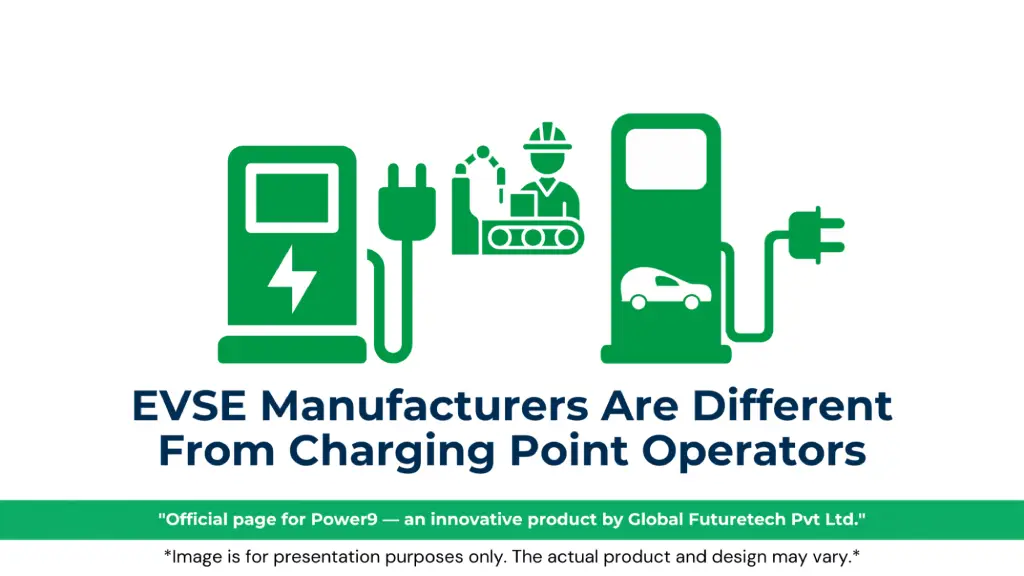
NITI Aayog’s e-Amrit platform has charging infrastructure manufacturers separate from Charging Point Operators.
We see charging infrastructure manufacturers as companies which produce and put out EV charge solutions. Their model may include hardware, software installation, maintenance and other support services.
A Charging Point Operator on the other hand runs a network of chargers and provides charging related services. (e-AMRIT).
When a business looks into EVSE manufacturers what they are mainly interested in is the companies which produce the charging hardware.
That is different from searching for a charging network where drivers can stop and charge.
For B2B procurement of parts and products, which in turn may range from industrial machinery to electrical components we see that this issue of distinction is key.
What Do EVSE Manufacturers Actually Do?
A genuine EVSE manufacturer may be involved across several stages of the product lifecycle.
It may start out at the stage of charger needs and electric structure and take off from there into mechanical design, part choice, power electronics, firmware, communication, safety features, production, quality check and document preparation.
The level of engineering ownership differs between companies.
Some EVSE manufacturers in India may design significant parts of the hardware and software themselves.
Others may integrate components or technology from specialist suppliers.
Neither approach should automatically be treated as good or bad.
The important question for a B2B buyer is:
Who owns the technical responsibility for the finished product?
If a charger develops a problem, buyers need to know who can understand and resolve it.
AC EVSE vs DC EVSE
A key aspect of assessing EVSE manufacturers is what type of charge your project requires AC, DC or a combination of both. With
AC EVSE
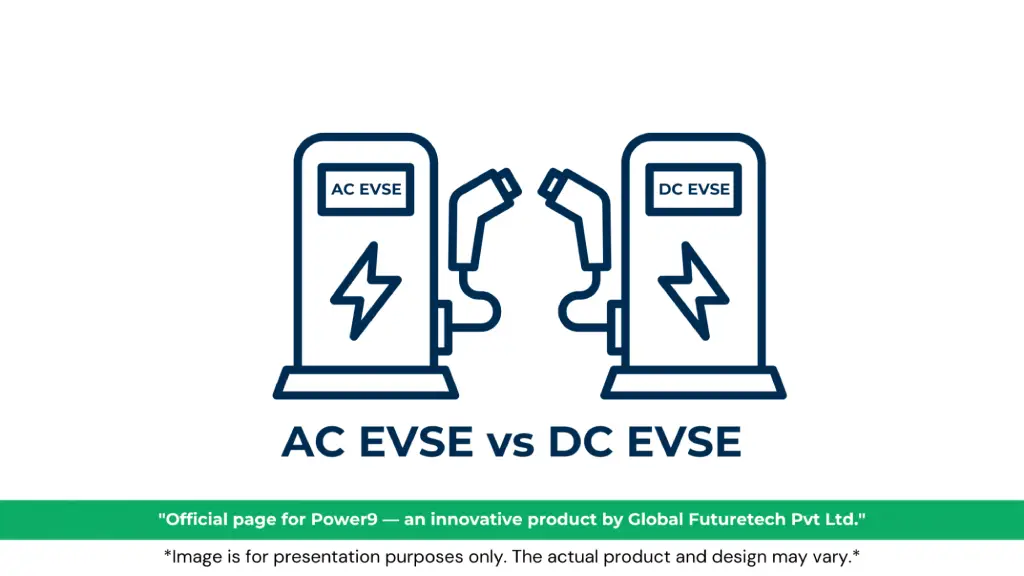
AC charging we see that the infrastructure supplies AC power to the vehicle. The car’s on board charger then transforms that power into DC which in turn charges the battery.
AC EVSE can work particularly well where vehicles remain parked for longer periods.
This can include workplaces, apartment parking, hotels, office campuses and selected commercial properties.
DC EVSE
A DC EVSE does the job of power conversion in the charging equipment and we put out DC electricity to the vehicle.
This usually makes the equipment more complex from a technical stand point and also which is to say that it supports applications which require quick turn around of vehicles.
We see this in commercial fleets, public charging, logistics and very high use charging stations.
When evaluating EVSE manufacturers in India, the goal should therefore not be to decide whether AC or DC is universally “better.”
The goal is to select the right architecture for the operation.
Compare the Complete EVSE Specification
One of the easiest mistakes in EV charging procurement is comparing only charger power.
A buyer may see two 30 kW chargers and assume they are technically equivalent.
They may not be.
A proper comparison between EVSE manufacturers should examine the complete specification.
|
EVSE Specification |
Why Buyers Should Check It |
|
AC or DC |
Defines basic charging architecture |
|
Rated power |
Shows maximum charging capability |
|
Input voltage / phases |
Determines site requirements |
|
Output voltage |
Critical for DC compatibility |
|
Maximum current |
Influences charging capability |
|
Connector |
Must match intended vehicle |
|
Number of connectors |
Affects simultaneous charging |
|
Efficiency |
Relevant to power-conversion losses |
|
Protection |
Important to electrical safety |
|
Communication |
Relevant to charger/vehicle/backend operation |
|
OCPP |
Important for managed charging |
|
Connectivity |
4G, Wi-Fi, LAN where supported |
|
Authentication |
RFID, QR, app etc. where applicable |
|
IP / IK rating |
Relevant to installation environment |
|
Operating temperature |
Important for Indian conditions |
|
Installation type |
Wall/pedestal/floor standing |
|
Warranty |
Lifecycle risk |
|
Documentation |
Important for engineering and maintenance |
Good EVSE manufacturers in India should make these specifications available rather than relying entirely on marketing descriptions.
Why Indian EVSE Standards Matter
EVSE is electrical infrastructure, so standards and technical requirements deserve serious attention.
NITI Aayog’s e-Amrit resource identifies IS 17017 as a key Indian charging standards family.
It is reported that IS 17017 Part 1 includes the basic features of EV charging systems which also is a part of the first issue of the said standard. Also what follows are separate parts of the standard which include details of connectors, AC/DC requirements and communication.
BIS has also updated the Indian DC EVSE framework.
IS 17017 (Part 23):2026 we see a report on DC Electric Vehicle Supply Equipment also which is based on IEC 61851-23:2023 with modifications for Indian conditions. BIS puts forth the requirements related to equipment that transmits energy from the supply network to the EV during DC charge events.
For buyers evaluating EVSE manufacturers, this creates a straightforward due-diligence requirement.
Do not accept:
“Our charger follows all international standards.”
Ask instead:
Which specific standard applies to this exact product?
Then ask for supporting evidence.
Certification, Standard and Protocol Are Not the Same Thing
This is particularly important for technical E-E-A-T.
An EVSE datasheet may contain:
CE
IEC
IS
OCPP
IP ratings
test-report references
These terms do not all mean the same thing.
A standard defines technical requirements.
A certification or test report provides a form of evidence against certain requirements.
A communication protocol such as OCPP defines how compatible systems communicate.
An IP rating describes enclosure protection under a defined classification system.
Reliable EVSE manufacturers in India should be able to distinguish these clearly.
For procurement teams, this is a simple but valuable credibility test.
Vehicle Compatibility Comes Before EVSE Selection
The charger and vehicle form one charging system.
A high-output charger will not automatically deliver its maximum power to every EV connected to it.
Vehicle architecture, charge rate, connector, battery state, temperature and charge curve also play a role in real charging performance.
Before going to the EVSE manufacturers for quotes, which is what businesses should do, they first put together a vehicle matrix of the vehicles that will use the infrastructure.
For fleets, include future vehicles where possible.
The EVSE may remain installed significantly longer than the current vehicle procurement cycle.
A charger selected only around today’s fleet can become a limitation later.
Site Electrical Capacity Can Change the Right EVSE Choice
A commercial charging project is not just an equipment purchase.
The site must support the electrical load.
Before comparing EVSE manufacturers in India, buyers should understand:
Available sanctioned load.
Transformer capacity where relevant.
Electrical distribution.
Existing site demand.
Expected simultaneous charging.
Future charger expansion.
In 2024 The Ministry of Power has put out EV charging guidelines which cover manufacturers, owners and operators of private, semi restricted and public charging infrastructure.
The guidelines are provisions which will see smooth electricity connection processes. As for owners you may go for Low Tension connections which are available for eligible EV charging loads up to 150 kW under this framework which the Power Ministry of India has put in place.
This means charger selection and electrical planning should happen together.
Why Load Management Matters
Imagine an office site that eventually has 20 charging points.
Design at full output for all chargers at the same time may create a much larger infrastructure demand then what is present in the site’s true operational profile.
Load management can help manage how available capacity is distributed across chargers.
When comparing EVSE manufacturers, ask whether their systems support functions such as:
Dynamic power allocation, charger scheduling, site-level limits and multi-charger management.
More importantly, ask how those functions actually work.
“Smart load management” is a marketing phrase until the manufacturer explains the control architecture.
OCPP and EVSE Interoperability
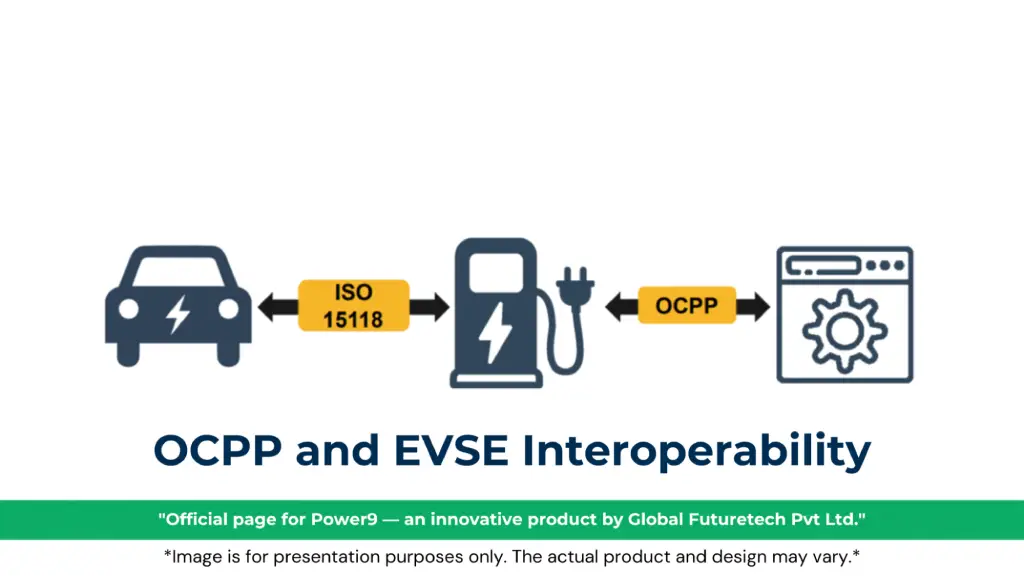
Connected EVSE can communicate with charging-management software.
In commercial and fleet based projects which put out charger monitoring, session control, user management, diagnostics and other network features we see.
The Ministry of Power has designed its EV charging framework for a connected and interoperable charging infrastructure network.
When evaluating EVSE manufacturers in India, ask:
Which OCPP version is supported?
Can the charger communicate with third-party systems?
Is the manufacturer’s own CMS mandatory?
Can backend providers be changed?
Are recurring software charges involved?
What functionality remains available without an internet connection?
How are firmware updates managed?
These questions become increasingly important as the number of chargers grows.
Connectivity Should Be Evaluated Operationally
A charger specification may list:
4G, Wi-Fi and LAN.
That sounds impressive.
But commercial buyers need operational answers.
Who supplies the SIM?
Who pays for mobile data?
Can charging continue if 4G fails?
Can Ethernet be used instead?
What firewall requirements exist?
Can connectivity be diagnosed remotely?
How does the charger reconnect?
The top EVSE manufacturers should present in practical terms what their communication architecture does instead of putting out a feature checklist
Examine Protection Architecture
EVSE operates around significant electrical loads.
Protection therefore needs product-level scrutiny.
As per the equipment and application charger architecture may have to put forth how it deals with abnormal conditions of voltage, current, temperature, short circuits, insulation, leakage, surges and emergency disconnection.
BIS has included in the 2026 DC EVSE framework updated requirements which include electric shock protection, over load and short circuit, cable assemblies and emergency disconnection.
When it comes to evaluation of EVSE manufacturers in India ask what the full system does in a fault state.
That which puts forth a more technical and meaningful discussion as opposed to just what is put forth in brochures.
Installation Is Part of EVSE Procurement
Even well-designed EVSE can perform poorly if installed incorrectly.
Commercial installations can involve:
Electrical distribution, cable sizing, earthing, physical installation, environmental clearances, network connection and commissioning.
Manufacturers’ installation documentation will detail the product specific requirements.
Also businesses should ask EVSE manufacturers what is the scope of installation they do themselves, what is done by authorized partners and what by independent qualified contractors.
Also confirm whether third-party installation affects the product warranty.
This should be agreed before the purchase order.
Commissioning Should Be Documented
A charger turning on does not necessarily mean the charging installation has been properly commissioned.
Depending on the project, commissioning can involve:
Electrical checks, start up validation, communication checks, authentication, charge session testing, fault tests and backend communication.
In large scale projects we ask for commissioning records.
This is especially true in which many parties are involved, for example the EVSE manufacturer, electrical contractor, software provider and customer.
Responsibility should be clear.
Warranty and Spare Parts Matter More Than the Brochure
One of the best ways to compare EVSE manufacturers in India is to look beyond the sale.
Ask:
When does the warranty begin?
Which components are covered?
What is excluded?
Who approves warranty claims?
Is onsite support available?
Who pays freight or travel?
How are spare parts stocked?
What happens after the warranty expires?
Is post-warranty maintenance available?
For fleet and commercial charging, downtime has financial and operational consequences.
Long-term serviceability should therefore form part of the procurement score—not remain an afterthought.
Evaluate the Manufacturer, Not Just the EVSE
A technically impressive charger from a company with weak support may still create risk.
When evaluating EVSE manufacturers, check the organisation behind the equipment.
Check out for a well defined legal entity, solid business address, technical team, manufacturing info, present product documentation, real photos, what the standards say we should see, warranty policies which are real and also genuine case studies.
This is also where E-E-A-T and GEO become relevant.
A company that issues out in depth which is also present and of which there is proof, gives to both the consumer and the AI search engines more data to go on.
EVSE Manufacturer Evaluation Scorecard
|
Procurement Area |
Recommended Importance |
|
Vehicle compatibility |
Very High |
|
Product specifications |
Very High |
|
AC/DC suitability |
Very High |
|
Applicable standards |
Very High |
|
Protection architecture |
Very High |
|
Electrical/site compatibility |
Very High |
|
OCPP/interoperability |
High |
|
Connectivity |
High |
|
Load management |
High |
|
Installation requirements |
High |
|
Documentation |
High |
|
Warranty |
Very High |
|
Spare parts |
Very High |
|
Technical support |
Very High |
|
Scalability |
High |
|
Relevant project evidence |
High |
|
Total lifecycle cost |
Very High |
This in turn we put forth as a better way to compare EVSE manufacturers in India as opposed to rank companies only by price or marketing.
Where Power9 Fits Among EVSE Manufacturers in India
Power9 is the EV charging brand of Global Futuretech Private Limited.
Its present EVSE portfolio includes AC and DC charging solutions for various charging needs.
The current Power9 AC platform is a dual gun system which charges two compatible vehicles at the same time, also we have DC which puts out 20/30 kW for use in which faster vehicle turn around is an issue.
In India, which is a focus for business growth in the EVSE manufacturers in India, Power9 should be evaluated against the criteria put forth in this guide.
That means reviewing:
Product specifications.
Vehicle compatibility.
Electrical requirements.
Communication.
Protection.
OCPP.
Load management.
Installation requirements.
Warranty.
Technical support.
Long-term serviceability.
Power9 also does not have to put forth itself as the industry authority with vague claims like “Number one in India for EVSE.
Technical transparency creates stronger authority.
Why EVSE Content Is Important for AEO and GEO
EVSE is a very important term for Power9 which they use to connect with the engineers, BIS documents, EV policy resources and charging infrastructure buyers.
Users increasingly ask search and AI systems questions such as:
What does EVSE mean?
Who manufactures EVSE in India?
What is the difference between EVSE and an EV charger?
What standards apply to EVSE in India?
Which EVSE is suitable for fleet charging?
A page which gives direct answers then supports those answers with government data and real product info has greater citation value than a generic “best charger manufacturer” page.
For GEO, Power9 should therefore connect the following entities consistently:
Power9 → Global Futuretech Private Limited → EVSE → AC EVSE → DC EVSE → EV charging infrastructure → commercial charging → fleet charging → product models → technical documentation → Dadra works.
This gives generative systems a much clearer entity graph.
Frequently Asked Questions
1. What does EVSE stand for?
EVSE is a term which stands for Electric Vehicle Supply Equipment. It refers to the infrastructure that charges electric vehicles. As per the kind of the charging unit, EVSE also provides electrical protection, user authentication, communication, charge control, and access to backend systems.
2. What is the difference between EVSE and an EV charger?
In common use these terms are traded out between professionals and laymen, but EVSE is the larger more exact term which includes all types of equipment that safely plug in an EV to a power source. With AC charge we see the car’s on board charger take care of the main AC to DC conversion, at the same time the EVSE handles the issues of the electrical connection and control.
3. How should businesses compare EVSE manufacturers in India?
In common use these terms are traded out between professionals and laymen, but EVSE is the larger more exact term which includes all types of equipment that safely plug in an EV to a power source. With AC charge we see the car’s on board charger take care of the main AC to DC conversion, at the same time the EVSE handles the issues of the electrical connection and control.
4.What Indian standards apply to EVSE?
IS 17017 forms a major family of Indian standards for EV charging. NITI Aayog’s e-Amrit platform sets out the relevant AC and DC requirements, and BIS currently lists standards such as IS 17017 Part 23:2026 for DC EVSE.
5. What is AC EVSE?
AC EVSE provides AC electricity to an EV. The vehicle’s inboard charger transforms that AC power into DC for battery charge. AC EVSE is a good fit for when vehicles are parked for extended times, as is dependent on the vehicle and site needs.
6. What is DC EVSE?
DC EVSE does the job of electrical power conversion in the charging equipment and we see it used when very fast turn around of vehicles is a must. That said the actual charge rate also is a function of the charger’s capacity, vehicle limits and battery conditions.
7. Why is OCPP important for EVSE?
OCPP allows for interaction between compatible EVSE and charging management platforms. In terms of fleet, workplace or multi site charging this supports remote monitoring, session management and other connected features. Buyers should check the OCPP version which each manufacturer supports.
8. Does the highest-powered EVSE always provide the fastest charging?
No. Vehicle charge rates which is to say the charge capability of the vehicle itself is a factor which determines what power it will accept. Also into the equation are the site’s electrical capacity and the state of the battery which in turn affects charge rate. It is up to good EVSE manufacturers to put forth recommendations based on the true vehicle and operational requirements, not just the power rating.
9. What should buyers request from an EVSE manufacturer?
Request a current technical datasheet, applicable standards info, installation requirements, vehicle compatibility, communication specs, protection details, warranty terms, manuals and service info. For large scale projects also ask for related deployment evidence and a support escalation process.
10. Are EV charging stations licensed businesses in India?
The Government says EV charging stations can be set up without a licence, but the equipment must still comply with the relevant technical standards and Ministry of Power requirements.
11. How large is India's public EV charging network?
The Ministry of Heavy Industries had recorded 52,718 public charging stations as of 21 July 2026. Of these, 16,561 had fast chargers for cars.
Conclusion
Choosing between EVSE manufacturers in India requires more than comparing charger power and price.
EVSE is infrastructure.
The equipment has to work safely in the vehicle, electrical supply, installation setting, communication platform and operation model.
For commercial buyers, the evaluation should therefore begin with:
Vehicles → charging requirement → available charging window → electrical capacity.
Only once that is achieved should buyers look at EVSE manufacturers’ specs, standards, protection, OCPP, load management, installation, warranty and lifecycle support.
The right manufacturer should be able to explain not only:
“What does this charger do?”
but also:
“Why is this EVSE appropriate for your vehicles and your project?”
For Power9 we have an opportunity to establish ourselves as authorities in the industry by putting out technical information on EVSE that is founded. In fact we back this up with real product specs, engineering know-how, put forth transparent company info and government standards.
This we do better for B2B buyers, traditional SEO and AI search which in turn increases our visibility. We do this far better than just ranking through repeat manufacturer claims.
Planning AC or DC EV charging infrastructure? Share your vehicles, charger quantity, charging window, project location and electrical requirements with Power9 to discuss the appropriate EVSE configuration.
Reference Links
These are government or government-backed sources only no competitor links are included.
-
- NITI Aayog e-Amrit — Charging Infrastructure
Explains the role of charging infrastructure manufacturers and distinguishes them from Charging Point Operators.
https://e-amrit.niti.gov.in/infrastructure - NITI Aayog e-Amrit — BIS Standards for Electric Vehicle Charging
Government-backed information about IS 17017 and Indian AC/DC EVSE requirements.
https://e-amrit.niti.gov.in/bis-standard - Bureau of Indian Standards — IS 17017 Part 23:2026
Official BIS information on the revised Indian standard for DC Electric Vehicle Supply Equipment.
https://www.bis.gov.in/standard-of-the-month/ - Ministry of Power — Guidelines for Installation and Operation of Electric Vehicle Charging Infrastructure 2024
Current Government framework applying to manufacturers, owners and operators of charging infrastructure.
https://powermin.gov.in/sites/default/files/uploads/RS03022025_Eng_0.pdf - Ministry of Heavy Industries / PIB — Charging Stations for Electric Vehicles, July 2026
Official source for India’s current public charging infrastructure figures.
https://www.pib.gov.in/PressReleasePage.aspx - Ministry of Heavy Industries — PM E-DRIVE EVPCS Allocation
Confirms ₹2,000 crore allocation for public EV charging infrastructure on a pan-India basis.
https://www.pib.gov.in/PressReleasePage.aspx
- NITI Aayog e-Amrit — Charging Infrastructure