



A DC charger can look straightforward on a quotation: 20 kW, 30 kW, 60 kW, 120 kW or more.
But that data point doesn’t tell a procurement team much about how well the charger will perform for its vehicles, electrical infrastructure or operating schedule.
In terms of business, fleet operators and charge point operators when it comes to choose between DC fast charger manufacturers it is an engineering and lifecycle play not a simple hardware purchase.
The proper charger must integrate many layers at the same time. Its voltage and amperage must be right for the vehicle it is to power. The site must have the right electrical structure. Communication must work with what we choose as the back end. Protection systems must respond as they should. We must have access to spare parts and tech support post go live.
India is seeing great growth in our charging infrastructure. The Ministry of Heavy Industries reported 52,718 public charging stations as of 21 July 2026 which includes 16,561 were equipped with fast EV chargers for cars. The Government has put forward Rs 2,000 crore into PM E-DRIVE for EV public charging infrastructure.
In the field of EV DC fast charger manufacturers which is growing we see an increase in choice for procurement teams but also an issue of greater technical due diligence.
The question should not be:
Which company offers the biggest charger?
The better question is:
Which manufacturer can provide a charger that fits our vehicles, charging window, site power and long-term operating requirements?
Quick Answer: How Do You Choose a DC Fast Charger Manufacturer?
When comparing DC fast charger manufacturers, examine the complete charging system rather than only rated kW.
A B2B buyer should evaluate:
- DC output power
- Operating voltage range
- Maximum current
- Vehicle compatibility
- Connector compatibility
- Electrical input
- Efficiency
- Thermal management
- Safety and protection
- Applicable standards
- OCPP
- Network connectivity
- Load management
- Charging-management software
- Installation requirements
- Warranty
- Service
- Spare parts
- Scalability
- Total cost of ownership
A capable manufacturer should also explain why its recommended charger is suitable for the project.
That which we present is perhaps the best method to tell strong EV DC fast charger manufacturers from companies that are just in the business of reselling equipment.
What Is a DC Fast Charger?
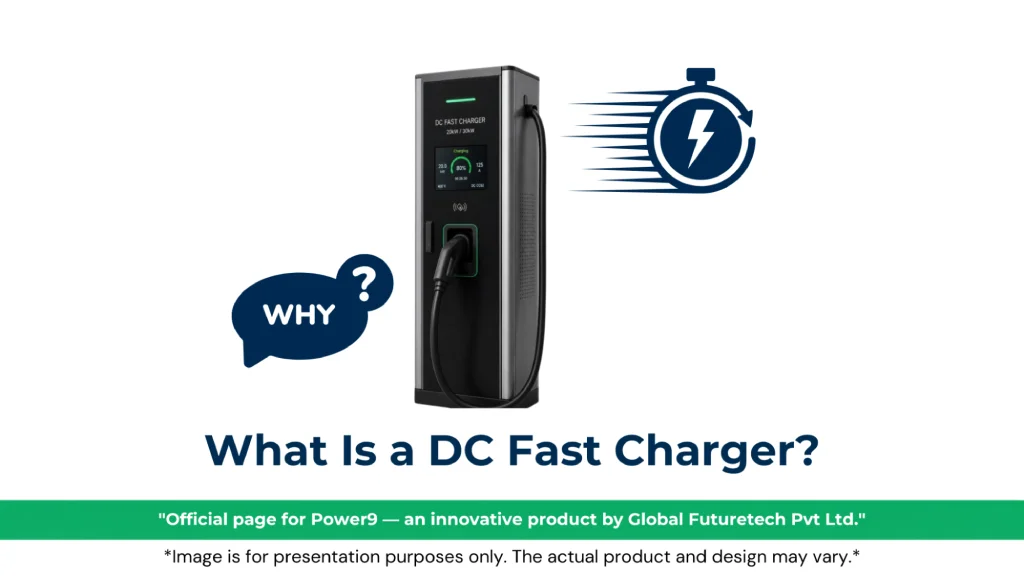
A DC fast charger transforms electrical power in the charge point infrastructure before providing DC power to the EV battery.
In the case of AC charging what we have is the vehicle’s use of the AC power that comes in and the conversion is done by the car ‘s on-board charge.
In the charging equipment is what does the conversion do which in turn supports that DC chargers are used in applications which do well with reduced charging times.
Typical examples include:
Commercial fleets, logistics operations, high use charging stations, public charging locations and the like which see vehicles out of charge for only short periods.
NITI Aayog’s e-Amrit resource outlines India’s EV charging ecosystem across AC and DC categories, noting that DC systems operate across wider voltage and power ranges.
However in some cases two products labeled as DC fast chargers may have very different electrical and performance features.
That is which we have to look at more than the category name in terms of DC fast charger manufacturers.
Why Manufacturer Selection Matters More for DC Charging
DC fast charging equipment incorporates several interacting systems.
In terms of design architecture these may include power conversion modules, controllers, contactors, insulation monitoring, metering, cooling systems, vehicle communication, displays, authentication, communications hardware and protective systems.
A failure may come from hardware, firmware, communication, electrical supply, network connectivity or installation.
In terms of what businesses are doing when they compare EV DC fast charger manufacturers,technical support quality is almost as much as what the initial charger spec is.
A strong manufacturer should be able to answer three questions clearly:
What does the charger do?
Why is it suitable for our project?
What happens if something goes wrong?
1. Start With the Vehicles Before Looking at Charger Power
One of the most common procurement mistakes is beginning with charger kW.
Before approaching DC fast charger manufacturers, build a vehicle matrix.
|
Vehicle Information |
Why It Matters |
|
Vehicle make/model |
Establishes exact requirement |
|
Battery capacity |
Helps estimate energy demand |
|
DC charging capability |
Confirms fast-charging support |
|
Maximum vehicle charging rate |
Prevents unnecessary oversizing |
|
Connector |
Confirms interface compatibility |
|
Typical daily distance |
Helps estimate energy consumption |
|
Arrival state of charge |
Helps calculate charging requirement |
|
Parking duration |
Defines charging window |
|
Required departure time |
Determines operational urgency |
Consider a fleet vehicle that returns at 8 PM and leaves at 7 AM.
Now compare that with another vehicle returning at 4 PM and leaving again at 6 PM.
The second vehicle may require significantly faster charging despite having a similar battery.
Good EV DC fast charger manufacturers should present to you these operational differences before putting forth their product.
2. Match Charger kW to the Real Charging Window
Higher charging power can be valuable, but it is not automatically better.
Suppose the car only requires 40 kWh of charge and is going to be parked for many hours. We may see that to a great degree charging infrastructure is installed beyond what is required by the present need which in turn increases equipment and electrical infrastructure costs without that which may bring in equal return for the business.
Conversely also we see that with too small a charger commercial vehicles can be left out of service when they are to return back in.
Ask shortlisted DC fast charger manufacturers to explain their sizing calculation.
The recommendation should consider:
Energy needed ÷ available charging time
while also accounting for:
- vehicle charging limits,
- battery behaviour,
- site constraints,
- simultaneous charging,
- future expansion.
This is more useful than comparing charger nameplates alone.
3. Pay Close Attention to DC Output Voltage
Voltage range is one of the most important specifications on a DC charger datasheet.
Modern in that EV battery architectures put out varying voltages. The charging equipment must have a right DC range of operation for the cars it will charge.
BIS’s current IS 17017 (Part 23):2026 Electric Vehicle Supply Equipment is covered which is applied within certain AC/DC grid-side and vehicle-side voltage parameters. The 2026 revision is based on IEC 61851-23:2023 which we see as a base but also include modifications for Indian conditions
When comparing EV DC fast charger manufacturers, examine:
- Minimum DC voltage
- Maximum DC voltage
- Maximum current
- Rated output
- Performance across the operating range
A 30 kW label does not tell you all of this.
4. Compare Power, Voltage and Current Together
Power cannot be evaluated independently of voltage and current.
In simplified terms:
Power ≈ Voltage × Current
That which a charger’s maximum power output may vary by the point at which the vehicle is operating in the supported voltage and current range.
In the evaluation of DC fast charger manufacturers, by procurement teams this is important to note that two chargers which have similar rated power may perform differently with different vehicles.
Always request the complete output curve or technical explanation where relevant.
For a fleet with several EV models, this becomes even more important.
5. Confirm Connector Compatibility Before Procurement
Never assume compatibility simply because both products are described as DC chargers.
The charger connector has to match the vehicle.
NITI Aayog’s e-Amrit report which details out various connector systems used in DC charging reports that it includes CCS family and other charging interfaces.
Before you compare quotes from EV DC fast charger manufacturers present the exact vehicles that will use the infrastructure.
Then request written confirmation of compatibility.
For mixed fleets, also consider future vehicles.
The charger may remain operational far longer than the current vehicle procurement cycle.
6. Evaluate the Current Indian Standards
Standards should be one of the first technical checks—not a logo collection placed at the bottom of a brochure.
In IS 17017 (Part 23):2026 we see the first revision of the standard which includes topics like protection against electric shock, overload and short circuit, cable assemblies, emergency disconnection, digital communication and other DC EVSE requirements.
NITI Aayog’s e-Amrit portal reports that IS 17017 is a key Indian EV charging standard.
When comparing DC fast charger manufacturers, ask:
Which standard applies to this exact charger?
Has the exact model/configuration been tested?
Can supporting evidence be provided?
Which claims are certifications and which are standards references?
Which test laboratory was involved?
A credible manufacturer should distinguish clearly between standards, certifications, test reports and protocols.
7. Examine Protection and Safety Architecture

A DC charger is a device which handles large amounts of electrical power, therefore protection must be a primary focus in its design.
Depending on the charger architecture, buyers may need to evaluate protection relating to:
Over voltage, under voltage, over current, short circuit, over temperature, electrical leakage, insulation faults, surge conditions and emergency shutdown.
In the 2026 BIS DC EVSE revision safety provisions which include protective-conductor checks, cable assembly requirements, short circuit emergency shutdown and under voltage protection at the vehicle connector are added or updated.
Do not ask EV DC fast charger manufacturers merely:
“Does the charger have protection?”
Ask:
“How does the charger respond when each relevant fault condition occurs?”
The second question reveals far more about engineering quality.
8. Check Efficiency and Thermal Management
Power-conversion losses create heat.
That makes charger efficiency and thermal design important for performance and component life.
Ask DC fast charger manufacturers about:
- Rated efficiency
- Measurement conditions
- Cooling method
- Fan/control strategy
- Operating-temperature range
- Derating behaviour
- Maintenance of cooling components
India-specific conditions are also relevant.
BIS reports that for the 2026 DC EVSE update they have raised the ambient test temp to 55°C, which is an increase from the 40°C in the base IEC document.
For outdoor and semi-outdoor commercial installations, thermal design should therefore be considered carefully.
9. Do Not Treat OCPP as a Yes/No Feature
Many charger brochures contain:
OCPP Compatible
That is not enough information.
When comparing EV DC fast charger manufacturers, ask:
Which OCPP version?
Can it work with a third-party CMS?
Has interoperability been tested?
Can the owner change the backend provider later?
Can charging continue when connectivity is unavailable?
How are firmware updates performed?
Are any recurring software fees required?
In 2024 the Ministry of Power presents a plan which will see the creation of an integrated national charging network.
For fleet operators and charging network businesses we see that which out of software lock in is not in fact necessary has great long term value.
10. Examine Charger Connectivity
Commercial chargers may use:
4G
Wi-Fi
Ethernet/LAN
But connectivity options should be evaluated operationally.
Ask DC fast charger manufacturers:
Who provides the SIM?
Who pays data charges?
Can Ethernet act as backup?
How does the charger reconnect after a network interruption?
Does charging remain possible offline?
Are firewall or network configurations required?
Who monitors connectivity problems?
A charger showing “4G/Wi-Fi/LAN” on its brochure does not automatically answer those questions.
11. Evaluate Load Management Before Building Multiple Charging Bays
Imagine a site installing 10 or 20 DC chargers.
The combined theoretical maximum load could create significant electrical infrastructure requirements.
But every vehicle may not need full charger capacity simultaneously.
Dynamic load management may also present itself as a solution that which will put into play the distribution of present charging resources among many chargers by what is required at a given site and at which the system is at.
When comparing EV DC fast charger manufacturers, ask them to explain:
How available power is measured.
How power is distributed.
Whether vehicle priorities can be set.
Whether scheduling is supported.
How the system responds if communication fails.
How additional chargers are added later.
In 2024 the Power Ministry has included that which pertains to the setup of EV charge points into the framework also we see in the plan an option for LT connection for which the load is up to 150 kW for eligible cases
12. Understand the Charger Management System
The hardware is only part of a commercial charging operation.
A CMS may allow teams to see:
- Charger online/offline status
- Charging sessions
- Energy consumption
- Fault alerts
- User information
- Multiple locations
- Remote controls
- Historical data
Before selecting between DC fast charger manufacturers, clarify who supplies this software.
Is it owned by the manufacturer?
Provided by another company?
Optional?
Subscription-based?
Included in the quotation?
Who owns the data?
Can the customer export it?
For operators planning multi-site infrastructure, these details become strategically important.
13. Look at Installation Requirements Before Accepting the Hardware Price

DC charging infrastructure involves more than purchasing the charger.
Potential site costs include:
Electrical panels, cable, protection equipment, earthing, civil foundations, networking and commissioning.
In 2024 the Power Ministry has put forth charging infrastructure guidelines which will apply to private parking, semi restricted sites, public commercial places and highways.
Ask EV DC fast charger manufacturers for installation requirements before final commercial approval.
A charger that appears cheaper may require more expensive site infrastructure.
Procurement should compare the complete installed solution.
14. Ask Who Performs Commissioning
A charger is not properly commissioned merely because its display turns on.
Commissioning may require:
Electrical tests
Communication validation
Authentication tests
Vehicle charging tests
Emergency-stop checks
Fault verification
Backend communication
Remote-management validation
Ask DC fast charger manufacturers how commissioning is done by them directly, through an authorized partner, or via the customer’s contractor.
For large projects, request documented commissioning results.
15. Look Beyond the Warranty Period
A charger warranty is only useful when its terms are clear.
Instead of asking:
“How many years of warranty?”
Ask EV DC fast charger manufacturers:
When does warranty begin?
Which components are covered?
Which are excluded?
Are power modules covered?
Is the display covered?
Are connectors/cables covered?
Who pays for travel?
Who pays freight?
Does third-party installation affect warranty?
What happens after replacement?
These details can materially change lifecycle economics.
16. Check Spare-Part Availability

For charge point operators, downtime can mean lost charging revenue.
For fleet businesses, it can mean unavailable vehicles.
Ask manufacturers about availability of:
Power modules
Controller boards
Charging cables
Connectors
Displays
Fans
Communication modules
Contactors
Other major field-replaceable components
The best DC fast charger manufacturers should be able to detail how they manage service and spare parts post sale.
17. Assess Remote Diagnostics and Technical Escalation
Commercial charging faults are not always hardware failures.
The problem could involve:
Vehicle communication
Site power
Backend software
Network connectivity
Firmware
Installation
Hardware
Therefore, before selecting between EV DC fast charger manufacturers, ask for a support escalation structure.
Who receives the first complaint?
Can engineers access fault logs?
Can problems be diagnosed remotely?
Who can deploy firmware updates?
Who attends the site?
What is the escalation process for recurring faults?
For large infrastructure projects, written support procedures are preferable to vague assurances.
18. Calculate Total Cost of Ownership
The initial charger price can be misleading.
A complete commercial evaluation should include:
|
Cost Area |
What to Calculate |
|
Charger |
Hardware price |
|
Shipping |
Freight to site |
|
Electrical infrastructure |
Panels, cables, protection |
|
Installation |
Electrical + civil |
|
Commissioning |
Setup and testing |
|
CMS |
Software/subscription |
|
Connectivity |
SIM/network |
|
Maintenance |
Preventive/corrective |
|
Spare parts |
Replacement components |
|
Warranty extensions |
If applicable |
|
Downtime |
Operational/revenue impact |
|
Expansion |
Future capacity |
The bottom in price from DC fast charger manufacturers may in fact end up being more expensive over the life of the product.
19. Ask for Real Project Evidence
Product brochures tell you what a charger is designed to do.
Real projects tell you how a company handles deployment.
Ask shortlisted EV DC fast charger manufacturers for evidence relevant to your application.
For a fleet project, ask for fleet experience.
For a charging operator, ask for multi-charger commercial deployments.
Useful evidence can include:
Number of chargers
Vehicle/application
Site environment
Installation approach
Operational period
Maintenance experience
Measured performance where available
Customer references where permission exists
This is one of the strongest E-E-A-T checks a B2B buyer can make.
20. Plan the Next Phase Before Buying Phase One

Many EV charging projects begin as pilots.
A site may start with two chargers and later require 10.
A fleet may electrify 10 vehicles before moving to 100.
A charge point operator may add new locations every quarter.
Ask DC fast charger manufacturers:
Can more chargers connect to the existing CMS?
Can AC and DC chargers be managed together?
Does load management scale?
Can multiple sites be monitored centrally?
Will future chargers remain interoperable?
Can electrical expansion be staged?
Your first charger should not unnecessarily limit your future network.
DC Fast Charger Procurement Checklist
Before issuing the purchase order, obtain clear answers to these questions:
|
Procurement Check |
Status |
|
Vehicle compatibility confirmed |
☐ |
|
Required charging window calculated |
☐ |
|
Voltage range checked |
☐ |
|
Maximum current reviewed |
☐ |
|
Connector confirmed |
☐ |
|
Applicable standards verified |
☐ |
|
Protection architecture reviewed |
☐ |
|
Efficiency checked |
☐ |
|
Operating temperature reviewed |
☐ |
|
IP/IK rating confirmed |
☐ |
|
OCPP version confirmed |
☐ |
|
Backend interoperability checked |
☐ |
|
Load management demonstrated |
☐ |
|
Site electrical capacity assessed |
☐ |
|
Installation scope defined |
☐ |
|
Commissioning responsibility defined |
☐ |
|
Warranty reviewed |
☐ |
|
Spare parts confirmed |
☐ |
|
Support escalation documented |
☐ |
|
Lifecycle cost calculated |
☐ |
This checklist makes comparing EV DC fast charger manufacturers substantially more objective.
Power9 20/30 kW DC Fast Charging Solution
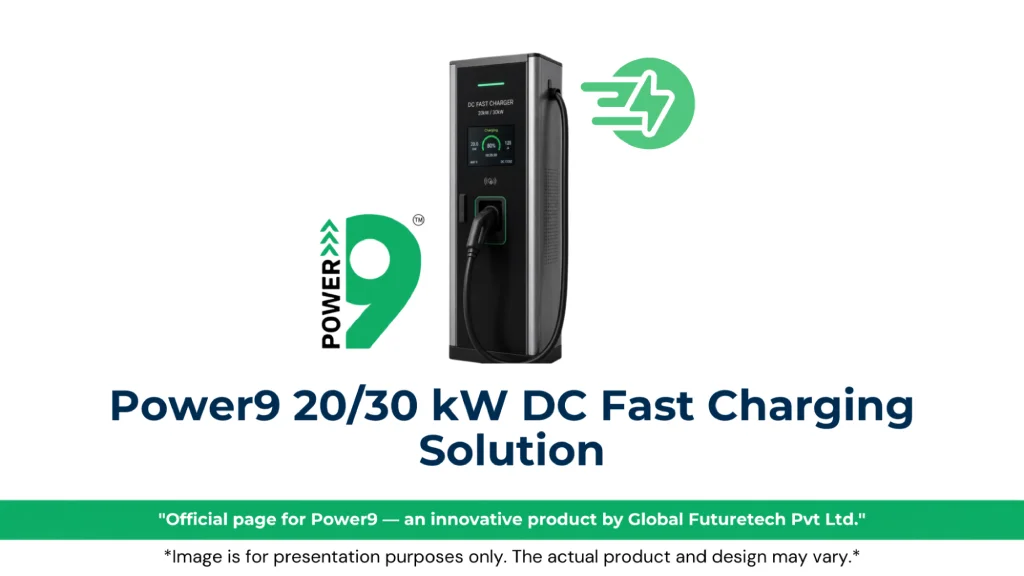
Power9 is the EV charging brand of Global Futuretech Private Limited.
At present our DC product line up includes the Power9 ES-DC30S, which we have designed to offer a choice between 20 kW or 30 kW output.
Based on Power9’s current technical product information, the platform includes:
20 / 30 kW selectable output
200–1000 V DC output range
125 A maximum output current
380–415 V AC three-phase input
7-inch touchscreen
4G, Wi-Fi and LAN
OCPP 2.0.1 with backward 1.6J compatibility
Dynamic load-management capability
Charging scheduling
Remote-management functionality
IP54 enclosure
For businesses that are to compare DC fast charger manufacturers, they should evaluate these specs against the intended vehicle and site which is of primary importance.
Power9 also has to go over the final connector language for this charger before we put out connector focused web content or SEO info out there because at present the technical docs require that we go in and make some changes to that field.
Technical transparency builds more trust than hiding documentation discrepancies.
Frequently Asked Questions
1. How should businesses compare DC fast charger manufacturers?
Businesses may look at which DC fast charger manufacturers to use based on charger power, voltage range, current, vehicle and connector compatibility, applicable standards, safety features, OCPP, connectivity, load management, software, installation requirements, warranty, service, spare parts and total lifecycle cost.
2. What is a DC fast charger?
A DC fast charger takes in electrical power at the charger which it then delivers as DC power to the EV battery. This makes DC charging a good choice for when you have short charge times or quick turn around of vehicles.
3. Is a higher-power DC fast charger always better?
No. The EV may not support the full charge output of the charger. Also of issue is what the site’s power capacity is and the time which the charge takes. For good EV DC fast charger manufacturers they should base the charger size on real world requirements.
4. Why does DC charger voltage range matter?
Electric cars use various battery voltage systems. The charger’s voltage range which is used must therefore be the same as that of the car. Power, voltage and current should be looked at as a whole.
5. What is the current BIS standard for DC EVSE?
IS 17017 (Part 23):2026 DC Electric Vehicle Supply Equipment which is based on IEC 61851-23:2023 with changes for Indian conditions and which also includes updated technical and safety requirements.
6. What is OCPP in DC charging?
OCPP is a communication protocol which is used between compatible chargers and charging management systems. As buyers compare DC fast charger manufacturers they should check the specific OCPP version and see if the charger is compatible with the intended backend.
7. Can a 30 kW charger charge every EV at 30 kW?
No. The charger is a 30 kW unit which the vehicle regulates for how much charge it takes in. Also battery state, temperature and charging behavior play a role in what the actual charge rate is.
8. Is load management necessary for DC fast chargers?
At large scale charging stations or in which electrical capacity is limited it does. Load management tools may be used to control how charging demand is had out between different chargers.
9. What warranty questions should charging operators ask?
Ask what is included, warranty start date, what is excluded, terms of on site support, which is responsible for travel/freight, what the replacement policies are and post warranty support. This should be compared across EV DC fast charger manufacturers before purchase.
10. How many fast EV charging stations are currently available in India?
As per the report by the Ministry of Heavy Industries as of 21 July 2026 India had 52,718 public charging stations, of which 16,561 had fast EV charging facilities for cars.
11. Is an EV charging station licence required in India?
The Government reports that which is to set up EV charging stations is an unlicensed activity,although at the same time what is required is that they comply with the technical and electrical as well as Ministry of Power rules.
Conclusion
Selecting from DC fast charger manufacturers should never be reduced to:
“What is your price per kW?”
A better procurement process starts with the business operation.
Understand the vehicles.
Calculate the charging window.
Assess the electrical site.
Then compare:
Power
Voltage
Current
Compatibility
Safety
Standards
Thermal design
OCPP
Connectivity
Load management
CMS
Installation
Warranty
Support
Spare parts
Scalability
Lifecycle cost
The best EV DC fast charger manufacturers should present to you how all of the components of their systems will work for your particular project.
For commercial sites, fleet or charging networks what is presented is far more valuable than the charger which has the highest number in the product name.
Power9’s 20/30 kW DC charge platform is for commercial and fleet requirements which will be looked at in terms of vehicle fit, charging time and also site infrastructure.
Planning a DC charging project? Share your vehicle models, number of chargers, typical charging window, project location and electrical requirements with Power9 before finalising the charger configuration.
Reference Links
- Press Information Bureau / Ministry of Heavy Industries — Charging Stations for Electric Vehicles, July 2026
Official source for India’s current public and fast-charging station figures and the ₹2,000 crore PM E-DRIVE EVPCS allocation. (Press Information Bureau)
View PIB charging infrastructure update - Bureau of Indian Standards — IS 17017 (Part 23):2026
Current BIS information on DC Electric Vehicle Supply Equipment and the 2026 revision. (Bureau of Indian Standards)
View BIS DC EVSE standard overview - Ministry of Power — Guidelines for Installation and Operation of EV Charging Infrastructure 2024
Official framework applying to manufacturers, owners and operators across private, semi-restricted, public and highway charging environments. (Power Ministry of India)
View Ministry of Power EV charging guidelines - NITI Aayog e-Amrit — Standards and Specifications
Government-backed information covering AC/DC charging categories and charging standards. (e-AMRIT)
View e-Amrit charging standards and specifications - NITI Aayog e-Amrit — BIS Standards for EV Charging
Overview of the IS 17017 EV charging standards family. (e-AMRIT)
View e-Amrit BIS standards guidance - PM E-DRIVE — Ministry of Heavy Industries
The scheme provides a ₹2,000 crore outlay for EV public charging infrastructure and proposes significant deployment of fast chargers across vehicle segments. (PM E-DRIVE)