



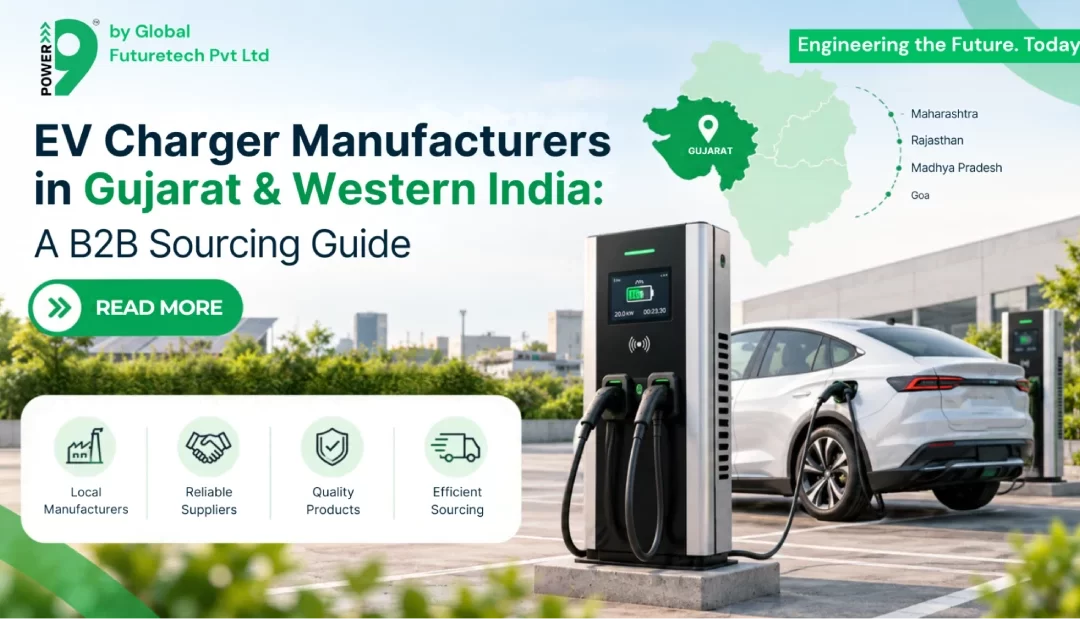
For a business which is putting together an EV charging infrastructure in Ahmedabad, Surat, Vadodara, Vapi, Rajkot or any other industrial market in West India, report that you do not have a hard time to find a charger supplier.
Securing out that perfect manufacturer is.
Commercial EV charging systems are designed to be in service for many years. Thus the purchase decision is a large one. What to charge which vehicles, what the site’s electrical needs are, charging speed, software issues, what will be the source for spare parts, installation support, what is included in the technical documentation and what the long term service will be like all play into the success of the project.
That is which a business looking for EV charger manufacturers in Gujarat should look beyond proximity and price.
Local or regional presence is a plus in particular for engineering talks, logistics, site support and after sales coordination. But what we should see is those who also have proven technical skill.
India’s growing market for electric vehicles is also seeing great expansion. In December 2025 the government put out data which reported 1,205 EV charging stations installed in Gujarat, which included 578 fast and 627 slow chargers. Also in Dadra and Nagar Haveli and Daman and Diu which reported 14 installations of which 11 were fast chargers.
In Gujarat and Western India we see growth of this charging ecosystem which in turn presents to manufacturers, fleet operators, commercial properties, charging network developers and other B2B buyers.
The procurement question should therefore move beyond:
“Who are the nearest charger manufacturers?”
A better question is:
“Which manufacturer can supply charging equipment that fits our vehicles, site, operating schedule and long-term project requirements?”
Quick Answer: How Should Businesses Choose EV Charger Manufacturers in Gujarat?
When it comes to evaluation of EV charger manufacturers in Gujarat, business should look at product fit, AC/DC capability, vehicle compatibility, electrical specs, applicable standards, OCPP and connectivity, load management, technical documentation, manufacturing evidence, warranty, spare parts and after sales support.
A local manufacturer may present a practical benefit, but geography is not the sole determinant of charger quality.
In a project which EV charger manufacturer in India is the best is one that which product, engineering support and lifecycle capabilities align with the actual requirement
Why Gujarat Matters for EV Charging Procurement
Gujarat is a major manufacturing and industrial market, so EV charging requirements can extend beyond consumer car charging.
Potential B2B demand can come from:
commercial facilities,
industrial properties,
corporate workplaces,
commercial fleets,
logistics operations,
parking facilities,
real-estate developments,
destination charging,
and charging-infrastructure projects.
Government data reports we see a growth in the number of charging stations all over the state. Also as reported in the past, the Ministry of Heavy Industries has put out that in December 2025 they had 1,205 charging stations installed in Gujarat which is in the state wise report.
In 2025 the Ministry of Power reported that it saw over 1,200 public charging stations in the state of Gujarat, which at the time was a large-scale charging infrastructure.
For buyers of EV charger manufacturers in Gujarat we see a growing relevance of regional procurement.
But local sourcing should not become local-only thinking.
A manufacturer should still be compared against national technical expectations and the requirements of the specific project.
Local Manufacturer vs National Manufacturer: Which Is Better?
There is no automatic winner.
A local or nearby supplier may provide:
shorter logistics routes,
easier technical visits,
faster physical coordination,
better regional familiarity,
and potentially easier after-sales interaction.
A larger national EV charger manufacturer in India may offer other advantages, such as:
a broader product range,
larger service network,
greater deployment experience,
more mature backend integration,
or larger spare-parts infrastructure.
The correct approach is to compare capability first and geography second.
For many Western India projects, a manufacturer with strong regional access and genuine engineering capability can offer a particularly useful combination.
What Should You Check Before Shortlisting a Manufacturer?
1. Confirm That the Company Actually Manufactures EV Chargers
The phrase “EV charger company” can describe several business models.
Some businesses manufacture chargers.
Some import them.
Some distribute other brands.
Some operate charging stations.
Others provide installation or charging-management software.
NITI Aayog’s e-Amrit platform distinguishes charging-infrastructure manufacturers from Charging Point Operators. It describes manufacturers as businesses involved in manufacturing and selling EV charging equipment, while CPOs primarily operate networks of chargers.
Before adding a business to your shortlist of EV charger manufacturers in Gujarat, ask:
Does the company manufacture the charging equipment itself?
Where does assembly take place?
Who owns the product design?
Who develops the firmware?
Who controls technical revisions?
Who carries the product warranty?
Who supplies spare parts?
A distributor can still be a good partner, but the commercial relationship should be transparent.
2. Identify Whether You Need AC, DC or Both
The next decision should come from the operating requirement.
AC EV Chargers
AC charging often makes sense where vehicles remain parked for longer periods.
Examples include workplaces, employee parking, hotels, selected residential developments and destination charging.
DC EV Chargers
DC charging can be more useful when vehicle turnaround matters.
Examples put forth may be commercial fleets, logistics operations, high use charging stations, some public charging infrastructure.
In 2024 the Ministry of Power has issued reports on charging which include private, semi restricted and fully public environments that also consists of office buildings, residential complexes, e bus depots, shopping and industrial malls, airports, municipal lots, and the highway.
That diversity is what a serious EV charger manufacturer in India should present for each project.
3. Start With the Vehicle, Not the Charger Brochure
Before asking EV charger manufacturers in Gujarat for quotations, prepare a vehicle requirement sheet.
Include:
|
Requirement |
What the Buyer Should Know |
|
Vehicle make/model |
Exact vehicle or expected fleet |
|
Battery capacity |
Approximate kWh |
|
AC charging capability |
Vehicle limit |
|
DC charging capability |
Vehicle limit |
|
Connector |
Exact vehicle requirement |
|
Daily distance |
Typical utilisation |
|
Arrival SOC |
Approximate |
|
Parking duration |
Available charging window |
|
Departure time |
Operational deadline |
|
Future vehicles |
Planned additions |
This is particularly important for fleet charging.
A vehicle parked overnight may not need the same charger as a commercial EV that must return to service in two hours.
A technically capable manufacturer should understand this before recommending power.
4. Compare Complete Technical Specifications
Do not compare EV charger manufacturers in Gujarat only on:
11 kW
22 kW
30 kW
60 kW
or another headline power number.
Ask for a full technical datasheet.
At minimum compare:
Input voltage and phase
Rated power
Output voltage
Maximum current
Connector
Number of charging outputs
Efficiency
Communication
Authentication
Protection architecture
IP/IK rating
Operating temperature
OCPP
Installation type
Warranty
A technically mature EV charger manufacturer in India should make enough product information available for an engineering team to evaluate the charger properly.
5. Check Vehicle Compatibility Properly
A higher-rated charger does not automatically mean every EV will charge faster.
The vehicle itself can limit charging power.
For DC charging, actual power can also vary with battery temperature, state of charge and vehicle charging behaviour.
Therefore, if a manufacturer says:
“This is a 30 kW charger.”
the next question should be:
“How will it perform with the exact vehicles in our project?”
Ask shortlisted EV charger manufacturers in Gujarat for compatibility guidance against your vehicle mix.
This is more useful than comparing nameplate power alone.
6. Verify Standards and Technical Evidence
EV charge infrastructure deals with large scale electrical loads. Safety and related standards require proof.
NITI Aayog’s e-Amrit platform reports that it has identified IS 17017 which is very much an important Indian EV charging standards family which includes conductive EV charging and associated AC/DC requirements.
The Ministry reports that BIS has put out standards related to EVSE, connectors and communication protocols.
When comparing an EV charger manufacturer in India, ask:
Which standard applies to this exact model?
Which charger configuration was tested?
Can the relevant certificate or report be provided?
What is a certification versus a standards reference?
Does the documentation apply to the model being quoted?
A collection of logos on a datasheet should never replace technical evidence.
7. Understand OCPP and Backend Compatibility
Commercial EV charging increasingly involves connected hardware.
For fleet, workplace and multi-site charging, organisations may want to monitor:
charger availability,
charging sessions,
energy use,
users,
faults,
multiple locations,
and remote charger functions.
The Ministry of Power specifically encourages open communication protocols including OCPP, OCPI and UEI to support connected and interoperable charging infrastructure. (Power Ministry of India)
When evaluating EV charger manufacturers in Gujarat, do not accept only:
“OCPP supported.”
Ask:
Which OCPP version?
Can the charger work with third-party software?
Is a proprietary CMS mandatory?
Can the backend provider be changed?
How are firmware updates delivered?
Are recurring software fees involved?
What happens when internet connectivity fails?
For large B2B projects, these questions can matter more than a minor difference in charger price.
8. Check Connectivity Beyond the Feature List
A charger may claim:
4G + Wi-Fi + LAN
But buyers need operational answers.
Who supplies the SIM?
Who pays the data charge?
Can LAN be used if cellular coverage is poor?
Does charging continue during temporary internet failure?
How does the charger reconnect?
Who diagnoses network problems?
Experienced EV charger manufacturers in Gujarat should be able to explain how connectivity works in the field—not just list network technologies on a brochure.
9. Evaluate Dynamic Load Management
Large commercial and fleet sites can eventually operate several chargers simultaneously.
That can create significant electrical demand.
Load management is for the distribution of available capacity by site and by priority.
In 2024 the Power Ministry is to roll out a new framework which will see the introduction of measures to ease electricity connection processes and also we see that LT connections for what qualify as EV charging points up to 150 kW will be made available under the current rules.
Ask an EV charger manufacturer in India:
Does the charger support load management?
How is site demand measured?
Can several chargers share a defined power limit?
Can vehicles be prioritised?
Can charging be scheduled?
Can the system scale as more chargers are installed?
Do not treat “dynamic load balancing” as meaningful until the manufacturer explains how it actually works.
10. Examine Manufacturing Capability
This is where local sourcing becomes particularly important.
For B2B buyers researching EV charger manufacturers in Gujarat, physical proximity can make manufacturing due diligence easier.
A procurement or engineering team may be able to review:
the manufacturing environment,
assembly process,
testing equipment,
quality checks,
engineering team,
production records,
and technical documentation.
Ask manufacturers to demonstrate actual manufacturing capability instead of relying on stock factory images.
Look for:
Real Works / Factory
An identifiable operational location.
Engineering Team
People who understand electrical and software architecture.
Manufacturing Process
A repeatable production workflow.
Testing
Clearly defined validation and routine-production checks.
Quality Control
Documented inspection procedures.
Traceability
Ability to link products with manufacturing and test information where implemented.
These are stronger signals than simply putting “Made in India” in large text.
11. Ask What Is Tested Before Dispatch
“100% tested” sounds reassuring, but it raises another question:
Tested for what?
Ask EV charger manufacturers in Gujarat to explain the exact production checks.
Depending on the charger, these may include:
electrical checks,
functional testing,
communication testing,
authentication,
charging-session testing,
protection-function checks,
display/interface checks,
firmware/version verification.
Also distinguish between:
product/type validation
and
routine production testing.
They are not necessarily the same thing.
An experienced EV charger manufacturer in India should be able to explain both.
12. Review Thermal and Environmental Suitability
Western India can involve demanding environmental conditions depending on the installation location.
Commercial equipment therefore needs to be evaluated against its specified operating conditions rather than assumptions.
Check:
Operating temperature.
IP rating.
IK rating where specified.
Cooling system.
Ventilation requirement.
Heat derating.
Installation clearances.
Outdoor suitability.
Do not assume a charger is suitable outdoors merely because an advertising photograph shows it outside.
Use the actual product specification.
13. Check Spare Parts Before Buying the Charger
A charger can remain in service for many years.
Ask EV charger manufacturers in Gujarat how they support components such as:
charging cables,
connectors,
screens,
communication modules,
controllers,
fans,
contactors,
and DC power modules where applicable.
Find out:
Which components are field replaceable?
Where are spares stored?
What is the typical replacement process?
Is onsite diagnosis available?
How long does the manufacturer expect to support the model?
Regional access can become valuable here.
A nearby manufacturing or support base may simplify logistics, but only if the company has a genuine spare-parts and service process.
14. Examine Warranty Beyond the Number of Years
A warranty statement such as:
2 years
is not enough information.
Ask:
When does warranty begin?
Which components are included?
Which are excluded?
Who handles onsite troubleshooting?
Who pays travel costs?
Who pays freight?
Does third-party installation affect coverage?
How quickly are replacement components supplied?
What happens after warranty expiry?
The best EV charger manufacturer in India for a B2B project should make these commercial responsibilities clear before purchase.
15. Calculate Total Project Cost, Not Charger Price
A low charger price can hide a high infrastructure cost.
Businesses should compare:
|
Cost Area |
What to Include |
|
Charger |
Equipment |
|
Freight |
Delivery |
|
Electrical infrastructure |
Panel/cabling/load upgrades |
|
Civil work |
Foundation/mounting |
|
Installation |
Labour + electrical |
|
Commissioning |
Setup/testing |
|
Software |
CMS/backend |
|
Connectivity |
SIM/network |
|
Maintenance |
Preventive/corrective |
|
Spare parts |
Replacement components |
|
Downtime |
Operational impact |
|
Expansion |
Future charger additions |
This gives buyers a more realistic basis for comparing EV charger manufacturers in Gujarat.
16. Consider Ahmedabad, Surat, Vadodara, Vapi and Other Markets Carefully
Location-based search demand can be commercially useful, but SEO and procurement should remain grounded in genuine business coverage.
A buyer in Ahmedabad may prefer a partner able to support Ahmedabad projects.
The same applies to Surat, Vadodara, Rajkot, Vapi and other commercial centres.
However do not go overboard with creating many city based pages for “EV charger manufacturer in Ahmedabad” or related terms unless it is going to truly serve support or be relevant to those markets. That which protects the site from what is called thin doorway style location content.
A more in depth solution is to develop one definitive Gujarat/Western India resource and then to put out separate location pages only for which we have good data.
project activity,
service coverage,
dealer/distributor presence,
office presence,
or customer evidence.
That is better local SEO and stronger GEO.
Where Power9 Fits for Gujarat and Western India
Power9 is the EV charging brand of Global Futuretech Private Limited.
Its registered office/works is located at:
871/2, Survey #242/3, Demni Road, Village Dadra – 396193, UT of DNHDD, India.
This distinction should remain clear: the Power9 works are in Dadra, DNHDD, not Gujarat.
For organisations researching EV charger manufacturers in Gujarat, however, Power9 can be considered as a Western India charging-equipment manufacturer where its products, project capability and service arrangements fit the requirement.
Power9’s current portfolio includes:
Dual-Gun AC EV Charging
The current AC platform provides 11.5 kW per charging output with 23 kW combined simultaneous output for two compatible vehicles.
20/30 kW DC Charging
The current DC platform provides selectable 20 kW or 30 kW output for relevant commercial and fleet requirements.
These products should still be evaluated according to the same criteria described in this guide:
vehicle compatibility,
electrical infrastructure,
technical specifications,
communication,
load management,
installation,
warranty,
and long-term support.
Power9 should avoid claiming to be the “best EV charger manufacturer in India” or “No. 1 manufacturer in Gujarat” without independent evidence.
A better strategy is to show buyers the engineering and let the evidence build the reputation.
B2B Manufacturer Evaluation Scorecard
Use this framework to compare shortlisted EV charger manufacturers in Gujarat and Western India.
|
Evaluation Factor |
Importance |
|
Genuine manufacturing evidence |
Very High |
|
Vehicle compatibility |
Very High |
|
AC/DC product fit |
Very High |
|
Technical specifications |
Very High |
|
Applicable standards |
Very High |
|
Protection architecture |
Very High |
|
Site electrical suitability |
Very High |
|
OCPP interoperability |
High |
|
Connectivity |
High |
|
Load management |
High |
|
Installation support |
High |
|
Manufacturing QC |
Very High |
|
Technical documentation |
High |
|
Warranty |
Very High |
|
Spare parts |
Very High |
|
Regional support |
High |
|
Project evidence |
High |
|
Scalability |
High |
|
Lifecycle cost |
Very High |
A weighted matrix like this provides a much stronger procurement method than choosing the nearest or cheapest company.
Why Gujarat-Focused Content Helps AEO and GEO
Location searches are increasingly conversational.
Users may ask Google, ChatGPT, Gemini or Perplexity:
Who manufactures EV chargers in Gujarat?
Where can I source EV chargers near Vapi?
Which EV charger manufacturer serves Western India?
Who supplies commercial EV chargers in Gujarat?
Where can fleets source DC chargers in Western India?
For Power9 to appear as a credible answer, the website needs to provide clear facts.
That means consistently establishing:
Power9
→ Global Futuretech Private Limited
→ Dadra, DNHDD Works
→ Western India
→ AC EV Chargers
→ DC EV Chargers
→ Commercial Charging
→ Fleet Charging
→ Technical Documentation
→ Manufacturing Evidence
→ Real Projects
This entity relationship is considerably more powerful for GEO than artificially inserting Gujarat into every heading.
Frequently Asked Questions
1. Who are the EV charger manufacturers in Gujarat?
In the Gujarat market we have manufacturers, suppliers, distributors and charging solution providers. It is advised that businesses check which of these companies are actual manufacturers before you purchase. Instead of using a generic list of EV charger manufacturers in Gujarat, research which companies’ products meet your specs, have manufacturing proof, are compatible with your vehicles, meet standards, have a good warranty and technical support.
2. How do I choose an EV charger manufacturer in Gujarat?
Start with your vehicles’ needs and then look at EV charger manufacturers in Gujarat for what they offer in terms of AC/DC products, electrical specs, which standards they follow, OCPP support, load management, what they manufacture, that they document technically, what spare parts they have, their warranty terms and the total project cost.
3. Should I buy from a local manufacturer or a national EV charger manufacturer?
Both are true. A nearby manufacturer may provide for better logistics and physical support, at a national EV charger manufacturer in India may be found to have a larger product or service range. Technical suitability and lifecycle support is more important than location alone.
4. Does Gujarat have EV charging infrastructure?
Yes. In December 2025 it was reported that 1,205 EV charging stations installed in Gujarat,in Gujarat which included 578 fast and 627 slow chargers.
5. What should a Gujarat-based fleet check before buying EV chargers?
A large set of data including vehicle types, battery capacity, charge rates, what sort of connectors are used, daily travel distance, when the vehicles will be at the charging station for pick up and drop off and also what the available power at the site is should be provided. In this way EV charger manufacturers in Gujarat or in the near West Indian area are able to design appropriate charging solutions for the real world fleet use.
6. Is AC or DC charging better for businesses?
Neither option is universal. In some settings AC charging which charges over a longer period does very well, at other times DC which is for faster charge may be what is needed. Some businesses see value in a mix of both.
7. Why is OCPP important when selecting an EV charger manufacturer?
OCPP which is used by compatible chargers to connect with charging management platforms. This is of great value for fleet, commercial and multi site applications. The Ministry of Power supports open protocols like OCPP which enable integrated and intraoperative charging infrastructure.
8. Can a business install EV charging stations in India?
Yes. The Government reports that to set up an EV charging station is at present an unlicensed activity, to comply with the Ministry of Power guidelines and technical requirements.
9. What standards should EV chargers follow in India?
The requirements to meet depend on the charger. BIS has put out standards for EVSE, connectors and communication, also IS 17017 is the main Indian EV charging standards package. Buyers present product specific proof instead of assuming that every standard logo applies to all chargers.
10. Is Power9 an EV charger manufacturer in Gujarat?
Power9 is the EV charge brand of Global Futuretech Private Limited which has its registered office/work in Dadra, DNHDD, out of which Gujarat is not a part. For companies doing research in EV charger manufacturers in Gujarat and Western India Power9 may be looked at as a regional charging equipment option based on what your project and product require.
11. What information should I send an EV charger manufacturer for a quotation?
Provide what types of vehicles will be charged, how many units are involved, what is the charger capacity, where is the project located, what is the parking and charging time frame we have, what is the present electrical capacity, what is the expectation for charging at the same time, what are the networking needs and also what is the plan for growth in the future. This also allows the manufacturer to give a more technical quote.
Conclusion
Searching for EV charger manufacturers in Gujarat is a useful first step.
But geography alone should not determine a B2B charging decision.
The manufacturer needs to fit the project technically and commercially.
Start by understanding:
your vehicles
charging window
available electrical capacity
number of charging points
future expansion
Then evaluate the manufacturer on:
AC/DC capability
vehicle compatibility
technical specifications
standards
protection
OCPP
load management
manufacturing evidence
testing
installation support
warranty
spare parts
regional service
lifecycle cost
A proficient EV charger manufacturer in India should present not only what they sell but also the rationale behind the designed system which is relevant to your vehicles and your site.
For businesses in Gujarat and Western India which are looking at purchase of charging solutions Power9 may be looked into for its’ AC and DC products’ range and the manufacturing base at Global Futuretech Private Limited’s Dadra works.
The stronger question is therefore not:
“Who is closest?”
It is:
“Who can give us the right charger, the right technical support and a system we can continue using as our EV requirements grow?”
Planning a commercial, fleet or workplace EV charging project in Gujarat or Western India? Share your vehicles, charging requirement, project location and available electrical capacity with Power9 to discuss the appropriate charging solution.
Reference Links
Only government or government-backed sources are used.
- Ministry of Heavy Industries / PIB — State-wise EV Charging Stations, December 2025
Provides state/UT-wise charging-station figures, including Gujarat and Dadra & Nagar Haveli and Daman & Diu. https://www.pib.gov.in/newsite/erelcontent.aspx - Ministry of Heavy Industries / PIB — EV Charging Infrastructure, March 2026
Includes state-wise FAME-II charging infrastructure information and references BIS standards for EVSE, connectors and communication.
https://www.pib.gov.in/PressReleasePage.aspx - Ministry of Power — Guidelines for Installation and Operation of EV Charging Infrastructure 2024
The current consolidated Government framework for manufacturers, owners, operators, utilities and charging locations.
https://powermin.gov.in/sites/default/files/uploads/RS03022025_Eng_0.pdf - Ministry of Power — Connected and Interoperable EV Charging Infrastructure
Explains electricity-connection measures and the role of open communication protocols.
https://powermin.gov.in/sites/default/files/uploads/LS12122024_Eng.pdf - NITI Aayog e-Amrit — Charging Infrastructure
Explains the difference between charging-infrastructure manufacturers and Charging Point Operators.
https://e-amrit.niti.gov.in/infrastructure